A coalition of water justice organisations across Africa has called on governments to reject water privatisation and increase public investment in water infrastructure to guarantee affordable and reliable access to safe water for all.
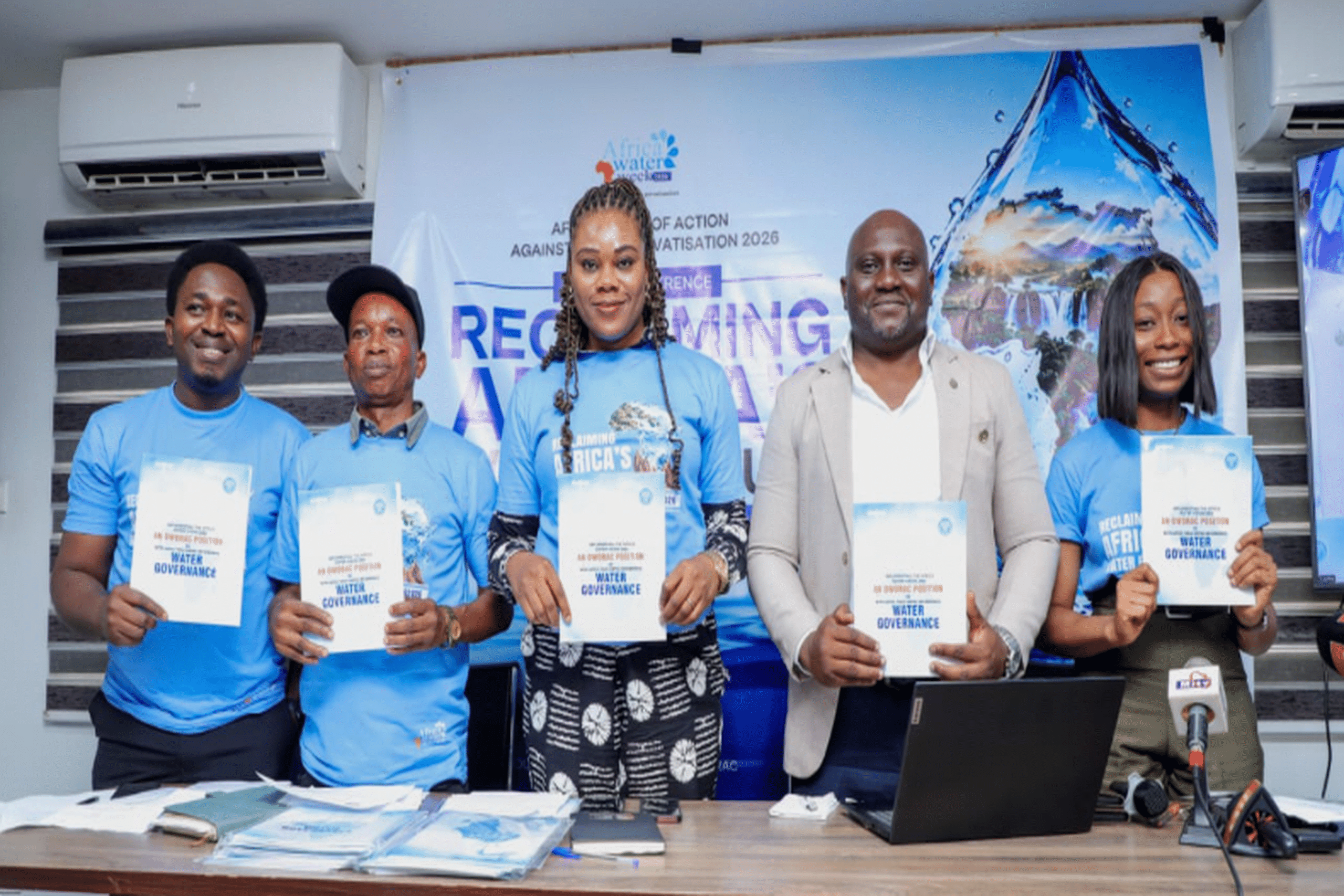
The Our Water, Our Right Africa Coalition (OWORAC) made the call in a statement marking the 2026 Africa Week of Action Against Water Privatisation, under the theme, “Reclaiming Africa’s Water Future: Public Water for All.”
The statement was read on Monday, October 26, at Ogba, Lagos.
The coalition argued that transferring responsibility for public water services to commercial interests would deepen existing inequalities, particularly for low-income households and underserved communities.
“OWORAC therefore calls on governments across the continent to ensure that Africa’s water future is shaped by the needs, rights and voices of the people who depend on water every day,” the statement said.
It expressed concern over the growing reliance on public-private partnerships, concessions, commercial tariffs, prepaid water meters and other arrangements that increase private-sector participation in water service delivery.
According to the coalition, “over the years, untold sums have been poured into efforts to privatise public water systems where that money and political will could be otherwise better spent on directly meeting the needs of people.”
While acknowledging the urgent need for investment in water and sanitation infrastructure, OWORAC maintained that the approach adopted by governments was equally important.
“Where access to water becomes increasingly dependent on people’s ability to pay before access, existing inequalities can be deepened rather than resolved,” it said.
The coalition also warned that privatisation schemes had a record of failures extending beyond unaffordable services to include infrastructure neglect, labour abuses and environmental degradation.
It added that inadequate public investment and administrative failures should not be used to justify transferring essential public responsibilities to private companies.
Citing the scale of the global water crisis, OWORAC said 2.1 billion people lacked safely managed drinking water in 2024, while 3.4 billion people lacked safely managed sanitation.
It noted that 167 million people in sub-Saharan Africa relied on limited drinking-water services in the same year, accounting for more than half of the global population using services at that level.
The statement said the situation disproportionately affected low-income households, rural communities and underserved urban and peri-urban settlements.
For many of these communities, the absence of reliable public water services meant relying on unsafe water sources or purchasing water from vendors, public standpipes, private boreholes, tankers and packaged-water suppliers without adequate guarantees of quality and safety.
The coalition cited research indicating that low-income households dependent on water vendors in urban sub-Saharan Africa could pay between 10 and 20 times more per unit of water than wealthier households connected to public networks.
“This is a poverty penalty in which those with the lowest incomes can end up paying the highest prices for an essential service,” it said.
OWORAC further raised concerns about the management of sanitation, wastewater and solid waste, warning that poor sanitation infrastructure and unmanaged waste continued to contaminate water bodies, undermine public health and worsen flooding in African cities.
It argued that outsourcing environmental services did not necessarily resolve these problems and could aggravate them.
The coalition cited allegations involving multinational water companies to support its concerns about private-sector involvement in essential services.
It referred to a 2025 report by Global Witness concerning Veolia, a multinational company involved in water and environmental services, which reportedly found that footage from a landfill managed by the company in Colombia appeared to show untreated leachate being discharged into waterways flowing into protected wetlands.
The statement also referred to allegations by the Gabonese state that petroleum waste had been found in “nearly all” pumping stations following years of Veolia’s operations in the country.
It further accused Suez, another multinational water company, of controlling urban and peri-urban water systems in Senegal to the detriment of local communities and workers, alongside allegations of significant financial mismanagement.
The coalition said such concerns had become more pressing as droughts, floods, pollution and other climate-related disruptions intensified water insecurity across the continent.
“Ordinarily, these realities should compel governments to strengthen public water institutions, publicly invest in resilient infrastructure and ensure that every community can rely on safe water,” it said.
“Instead, public-sector weakness is increasingly treated as an invitation for commercial intervention. OWORAC rejects this logic.”
The coalition insisted that Africa’s water future should be built around effective public institutions, adequate funding, resilient infrastructure and community participation rather than increased dependence on private investment.
“Africa’s water future cannot hinge on attracting more private investment. It must be built on functioning public water systems that people can rely on,” the statement added.
It urged governments to strengthen public water institutions, invest in water infrastructure and workers, improve data collection and planning, protect public water resources and ensure that communities participated in decisions affecting their access to water.
OWORAC also pointed to the African Union’s designation of 2026 as the Year of “Assuring Sustainable Water Availability and Safe Sanitation Systems to Achieve the Goals of Agenda 2063”, alongside the launch of the Africa Water Vision 2063 and Policy.
It said the 2026 United Nations Water Conference offered another opportunity to advance commitments on water and sanitation, but stressed that the commitments must translate into concrete action.
As part of its advocacy, the coalition said it had developed a position paper titled Implementing the Africa Water Vision 2063: An OWORAC Coalition Position on Water Justice, Public Financing and Democratic Water Governance.
The document examines opportunities and gaps in implementing the continental water vision and proposes measures to promote human rights, public accountability, adequate public financing and democratic governance of water resources.
Among other demands, the coalition called on African governments to make universal access to safe, affordable and reliable water and sanitation services a public responsibility and a human right.
It also urged governments to establish measurable national and regional financing commitments, including public investment benchmarks for water and sanitation, and adequately fund public water institutions and utilities.
Other demands included transparency in water-related contracts, agreements, financing arrangements, tariffs, allocations and expenditures, as well as meaningful participation by communities, workers, women and other affected groups in water governance.
The coalition called on governments to reject “privatisation, commercialisation, concessions, public-private partnerships, management and lease contracts, outsourcing, prepaid water-meter systems, and other arrangements that transfer the control or delivery of public water services to commercial interests.”
The statement was signed by 11 organisations, including the Senegalese Water Justice Network, Corporate Accountability and Public Participation Africa, Amaka Nweke Foundation, Water Citizens Network/Revenue Mobilisation Africa, Disability Not a Barrier Initiative, Cheriehomes Global Initiatives, Christian Initiative for Nation Building, Green Scenery, Voices for Water, Biodiversity and Biosafety Association of Kenya, and Corporate Accountability International.
Source: Pmnewsnigeria