Tobacco control in Nigeria continues to exist in a space shaped by three forces that never quite separate from one another. There is the obvious public health burden of addiction and disease. There is the economic and political power held by tobacco corporations. And there is the persistent fragility of the institutions meant to regulate them. It is inside this tension that a new generation of young advocates is now being prepared to intervene.
On September 29, 2025, Corporate Accountability and Public Participation Africa (CAPPA) hosted a capacity-building webinar for members of its Youth Network, a growing community of volunteers between the ages of 18 to 35.
More than 60 participants attended the training, which introduced them to the core pillars of tobacco control in Nigeria. They learned how the law is structured, how new nicotine products are entering the market, and how the tobacco industry continues to reinvent itself in order to stay ahead of regulation. The purpose of the session was not only to describe what the law contains, but to explain why surveillance matters, where corporate interference usually occurs, how young people can monitor it, and what tools they can use to respond.
Tobacco Control 101 — Setting the Groundwork
The opening presentation was delivered by Olawale Makanjuola, Coordinator of the Nigerian Tobacco Control Alliance (NTCA). His session, “Tobacco Control 101: A Starter Toolkit for Young Advocates,” provided a clear overview of how tobacco continues to harm populations globally and in Nigeria, using evidence-based data to show that the epidemic is neither accidental nor natural, but designed, marketed, and defended by industry actors.
To provide a clear structure for advocacy, he introduced the World Health Organisation’s MPOWER strategy, a six-part framework used across the world to reduce tobacco use. The strategy calls for countries and civil society to monitor tobacco use and industry tactics, protect people from second-hand smoke, offer help to quit, warn about the dangers of tobacco, enforce bans on advertising and sponsorship, and raise taxes on tobacco products. When all six elements are fully implemented, smoking rates fall, health costs drop, and corporate influence weakens.
Olawale ended the session by showing the different ways young people can take part in the movement. They can engage in policy work at national or state level. They can organise in schools and communities. They can use both digital and traditional media to shape public opinion. They can also keep watch on the tobacco industry and call out its attempts to influence policy and weaken regulation.
Understanding the Law and Its Gaps
The second session, led by Shade Osi from CAPPA’s legal team, focused on the laws that guide tobacco control in Nigeria and the weaknesses that still exist inside them. She explained how the country moved from signing the WHO Framework Convention on Tobacco Control (WHO FCTC) to passing its National Tobacco Control Act in 2015, then the National Tobacco Regulations in 2019, and later the National Film and Video Censors Board Regulation, also known as the Smoke-Free Nollywood law in 2024, which prohibits the glamourisation of smoking scenes in films.
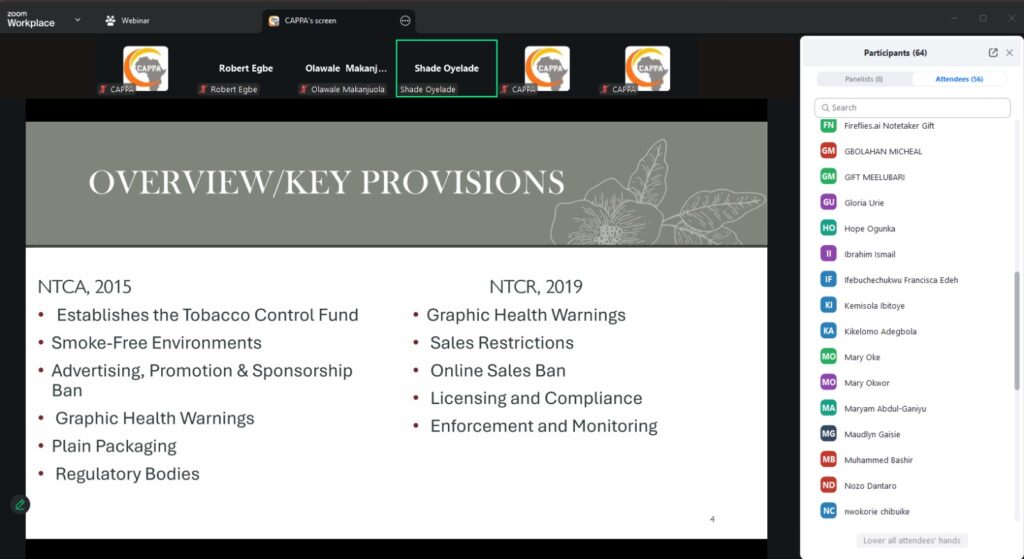
She broke down what these laws promise on paper. Smoke-free public places where people can breathe clean air. Health warnings that are clear and visible on tobacco products and packages. A ban on tobacco advertising, promotion and sponsorships. Licensing requirements for sellers. Age and sales restrictions. Penalties for those who break the law. All the features expected in a functioning control system.
The problem, she warned, is not the absence of laws but the absence of power to make them work. Enforcement in Nigeria remains weak because the agencies responsible lack the funding, tools, and political backing required to carry out their duties. This vacuum has allowed the tobacco industry to stretch the law and exploit loopholes, especially around new nicotine products that fall outside the legal definition of tobacco. As a result, products such as e-cigarettes, heated sticks, and nicotine pouches are being marketed to young people as harmless alternatives to cigarettes, grooming a new generation of users and deepening the cycle of addiction.
Monitoring the Industry
The final presentation was delivered by Humphrey Ukeaja, CAPPA’s Industry Monitoring Officer. His session focused on the mechanics of exposing tobacco industry interference. He explained that monitoring is not a passive activity, but a structured system of collecting evidence on the interference activities and actions of tobacco companies, their lobby groups, PR agencies, “corporate social responsibility” fronts, and third-party influencers.
Monitoring, he said, involves watching the way the industry markets and sponsors events both online and offline, tracing their attempts to interfere with policy through lobbying, political donations, or partnership offers, and building a network of informed observers and pro-health advocates who can quickly document and expose these tactics before they become normalised.

Humphrey stressed that advocacy cannot rely on assumptions. It needs proof. The more evidence there is of manipulation and interference, the harder it becomes for the industry to disguise itself as a harmless business. Monitoring therefore strengthens public campaigns, supports legal action, and prevents the industry from shaping the very laws that are meant to restrict it. He closed with his session with a reminder from Professor Stanton Glantz, Director of the Centre for Tobacco Control Research and Education, University of California, San Francisco:
The tobacco industry is an insidious enemy of public health, constantly adapting its strategies to undermine effective tobacco control policies. Continuous monitoring is essential not only to expose their new tactics but also to prevent their insidious influence from derailing efforts to protect public health. If you don’t watch them, they will kill you.
By the end of the webinar, the participants left with a clearer understanding of how tobacco control works in practice. They learned which laws exist, where the gaps are, what tools can be used to monitor the industry, and why it is important to challenge the power behind tobacco companies. The session also affirmed CAPPA’s continued commitment to supporting young persons in Nigeria and across Africa interested in public advocacy and social justice, using facts, evidence, and organised action to protect public health.