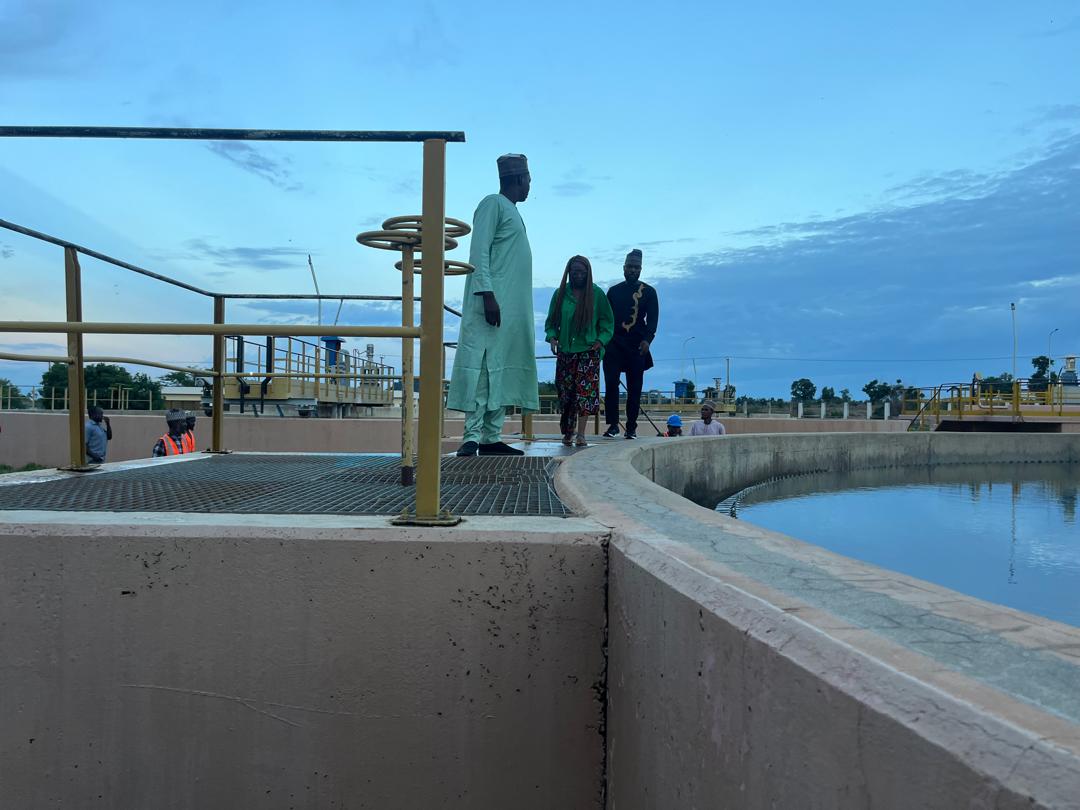
On the morning of Sunday, April 20, 2025, four men walked into the Gubi Water Treatment Plant and never returned alive. They were employees of the Bauchi State Urban Water and Sewerage Corporation, men whose daily labour kept water flowing from the Gubi Dam — the state’s largest reservoir — into many homes. By the end of that day, they had become victims of a preventable tragedy that exposed the thin line between routine work and mortal danger in one of Nigeria’s most vital public services.
Following initial news reports of the incident, Corporate Accountability and Public Participation Africa (CAPPA) undertook an independent investigation between July 20 and 21 to piece together the facts. Our findings reveal not only the immediate circumstances of the workers’ deaths but also the systemic conditions that made such a tragedy possible.
Facts Established
The dead were:
- Abdulmalik Ibrahim Hamza – Plant Operator (Package Plant), casual staff
- Jamilu Yunusa – Plant Operator (Package Plant), casual staff
- Ibrahim Musa – Senior Storekeeper, permanent staff
- Shuaibu Hamza – Principal Works Superintendent, permanent staff
The chain of events began the previous day. On Saturday, April 19, 2025, workers commenced a scheduled two-day maintenance of the plant’s clarifier units. During the exercise, one clarifier — Unit 101D — was discovered to have a faulty desludge valve. To carry out repairs, water was drained from the unit, leaving behind a thick layer of sludge at the bottom of the sedimentation tank. By evening, staff observed a strong sulphurous odour emanating from the tank, consistent with hydrogen sulphide, a toxic gas produced when aluminium sulphate (commonly known as alum) reacts with organic matter in stagnant water.
For clarity, it is important to know how the clarifier functions. As one plant official explained, the clarifier begins with the sedimentation tank — a wide, open basin into which raw water from the dam flows. Here, heavier particles settle to the bottom forming sludge. At the base of the tank are three pits fitted with valves. These valves control the release of sludge through connecting pipes into the desludge chamber, a smaller outlet where the waste is collected and eventually discharged.
“From time to time you have to desludge, that is remove the sediments,” the official said. “You just open the valve and then the sludge will come up — very stinking, smelly, and poisonous material.”
While the sedimentation tank is large and open enough to allow some air circulation, the desludge chamber is the opposite: narrow, confined, and prone to the build-up of toxic gases. When valves get clogged or fail, workers sometimes remove them entirely or even improvise by inserting flexible pipes or compressors to force the sludge through. This exposes them directly to fumes.
When work resumed the following morning, April 20, maintenance staff returned to continue the desludging process. Among them was Mr. Ahmadu Garba Mohammed, who entered the sedimentation tank as part of the task. While discharging sludge, he also removed some fishes that had drifted in with water from the dam. Later that morning, when he crossed to a smaller plant on site, operators Jamilu Yunusa and Abdulmalik Ibrahim Hamza noticed the fish in his hands. They asked whether more remained and when he confirmed, decided to go catch some themselves.


The two men first entered the sedimentation tank, gathered fish, and emerged unharmed. According to staff accounts, this was not unusual — workers had stepped into the tank many times before without incident. But what seemed routine quickly veered into disaster. Encouraged by their initial catch, Abdulmalik turned to the desludge chamber, the smaller and poorly ventilated pit connected to the clarifier, hoping to find more fish. However, within minutes of descending inside the space using a cable, he collapsed after inhaling toxic fumes.
Jamilu, who had been waiting outside, shouted for help but entered the chamber with a ladder before reinforcements arrived. He too was quickly incapacitated.
Their cries attracted Ibrahim Musa, a storekeeper who though not part of the maintenance crew, instinctively rushed in to help but also collapsed soon after entering the desludge chamber. Moments later, Shuaibu Hamza—Abdulmalik’s father and a senior supervisor—ignored pleas to stay away and entered the pit to initiate a rescue. He initially managed to climb back out but distressed at seeing three men trapped inside, forced his way in again. This time, he slipped on the ladder, struck his head, and fell across the outlet, blocking the sludge flow. The chamber began to fill, submerging the men. Eyewitnesses described seeing them gasping and jerking before the sludge covered their bodies.


A fifth worker reportedly attempted to join the rescue but was restrained by colleagues who had by then realised the situation was fatal. Although an oxygen tank and mask were available at the plant, workers on the ground could not operate them in the panic of the moment. An alarm was eventually raised and the Fire Service was called. By the time they arrived and retrieved the bodies, all four men were dead.
No autopsy was carried out because all the victims were muslims and Islamic rites require immediate burial. Nevertheless, CAPPA’s investigation, drawing on staff testimonies, site observations, and expert assessments, concluded that the men most likely died from acute exposure to hydrogen sulphide gas. Workers had reported a strong sulphurous odour from the sludge the previous day, and the corporation’s management also acknowledged that the sludge produced hydrogen sulphide fumes, intensified by the extreme heat on the day of the accident, which reached over 40°C.
Response of the State Government
Once the alarm was raised, the Fire Service responded promptly, successfully evacuating the bodies from the desludge chamber. According to eyewitnesses, both Engr. Aminu Gital (Managing Director of the Corporation) and Hon. Commissioner for Water Resources, Mr. Musa Dadi arrived at the scene within an hour of the incident. Although Bauchi State Governor Bala Mohammed was not in the state at the time, he visited the plant and met with the victims’ families upon his return. The Senator representing Bauchi Central, Senator Abdul Ningi, along with other political and traditional leaders, also visited the site to offer their condolences. The state government fully covered the burial expenses for all four victims.
Compensation
The Bauchi State Governor reportedly donated ₦5 million to each of the bereaved families. This financial support, described as a goodwill gesture, was given in recognition of the fact that the deceased were the primary breadwinners in their households. The funds were intended to help the families manage their daily needs during the mourning period. Family representatives collected the donations and submitted them to the Sharia Commission to ensure fair distribution among the wives, children, and other dependants of the dead men. In addition to cash donations, the Corporation and various political leaders also donated food items such as rice, cooking oil, and other essentials to support the grieving families.
Gratuities
According to the terms of their contracts, casual staff are not entitled to posthumous benefits from the Corporation. For permanent staff, the processing of their gratuities was reportedly underway at the time of CAPPA’s investigation.
OUR REFLECTIONS AND RECOMMENDATIONS
The deaths at Gubi cannot be dismissed as an isolated mishap or a freak accident, no matter how much they resemble one. Any genuine response and inquiry must therefore go deeper. It must confront three urgent questions: who does the work that keeps our public services running? Under what conditions are they compelled to do it? And why are they denied the dignity, protection, and recognition that their labour deserves?
1) Safety Protocols and Workplace Training
The first lesson from Gubi is that safety cannot be left to chance. At the plant there was an oxygen kit available, yet no one on the ground knew how to use it. Rescue attempts quickly turned into additional casualties because none of the workers had been trained in emergency response or in recognising the danger of toxic gases such as hydrogen sulphide. Protective gear was available but the rescuers rushed in without it, a fatal mistake that speaks not of individual recklessness but of systemic neglect.
The Factories Act remains the foundational HSE law in Nigeria, mandating the provision of a safe working environment, use of protective gear, and periodic safety training for workers. However, its enforcement is limited primarily to formal industrial facilities and fails to capture the unique operational realities of public infrastructure projects. Other legal instruments such as the Labour Act, and the Occupational safety and Health Act all allude to instruments of safety in the workplace however, implementation has remained weak as exemplified in the Gubi case. This should change.
A national directive should make periodic safety drills compulsory across all public utilities, with penalties for non-compliance. Workers must be trained to recognise hazards, use protective gear, and follow strict administrative controls such as signage, barriers, and restricted access whenever risks are observed.
2) Casualisation of Essential Workers
The Gubi tragedy sits within a wider national crisis. Across Nigeria’s labour market, casualisation has become the dominant mode of employment. Factories, banks, universities, oil installations, and now even public utilities rely on casual, or contract workers stripped of security, pensions, and benefits. This erosion of permanent employment has produced a generation of workers who carry out the same tasks as permanent staff yet live without the protections guaranteed by law or collective bargaining. Bauchi State Water Corporation for instance, employs 200 casual staff and about 206 permanent staff. The last time the state employed permanent staff was in 2013. What this means is that these 200 casual workers have spent over a decade in such a critical sector without stability guarantees. Two of the men who died at Gubi belonged to this category.
It is instructive to state here that this pattern has also been reinforced by international financial pressures. As CAPPA’s Big Debt, Big Thirst report shows, the Third National Urban Water Sector Reform Project (NUWSRP III) — a $65 million World Bank loan approved in 2014 and implemented in Bauchi from 2017 — tied disbursements to “cost recovery” and “low operational costs.” In practice, this has meant suppressing wage bills, freezing permanent recruitment, and relying on precarious labour.
Sadly, Nigeria’s labour laws neither explicitly endorse nor prohibit casualisation, leaving a vacuum that enables exploitation. The country has also failed to ratify International Labour Organisation (ILO) Convention 158, which promotes secure employment and fair termination procedures. While the National Industrial Court has in some cases relied on the principles of this Convention, there remains no comprehensive legal protection against casualisation. It is time has come to end this ambiguity. Nigeria must amend its labour laws to prohibit casualisation in essential service sectors such as water, energy, and health. Without decisive reform, tragedies like Gubi will continue to punish those already made most vulnerable by their conditions of employment.
3) Hazard Allowances for Water Workers
Finally, the tragedy underlines how little value is placed on the expertise and risk of water workers. Even as the Bauchi State Urban Water and Sewerage Corporation undergoes corporatisation under the NUWSRP III, its employees remain under the Consolidated Public Service Salary Structure (CONPSS). This scheme lumps them together with clerical staff and administrators, excluding hazard allowances, rural posting allowances, and inducement allowances. Yet their work requires engineering expertise, carries daily exposure to chemical, biological, and environmental hazards, and directly determines the health of entire communities.
In contrast, health workers operate under the Consolidated Health Salary Structure (CONHESS) or the Consolidated Medical Salary Structure (CONMESS), both of which recognise the technical nature of their work. The same logic should apply to water workers. They safeguard public health just as doctors and nurses do, only from a different angle. Without clean water, no hospital can function, and no community can thrive. Water workers should therefore be absorbed into a structure that reflects their occupational risks and professional expertise. Whether this is by inclusion in CONHESS or the creation of a new dedicated salary framework, the principle remains the same: to value their work is to value the health of the nation.