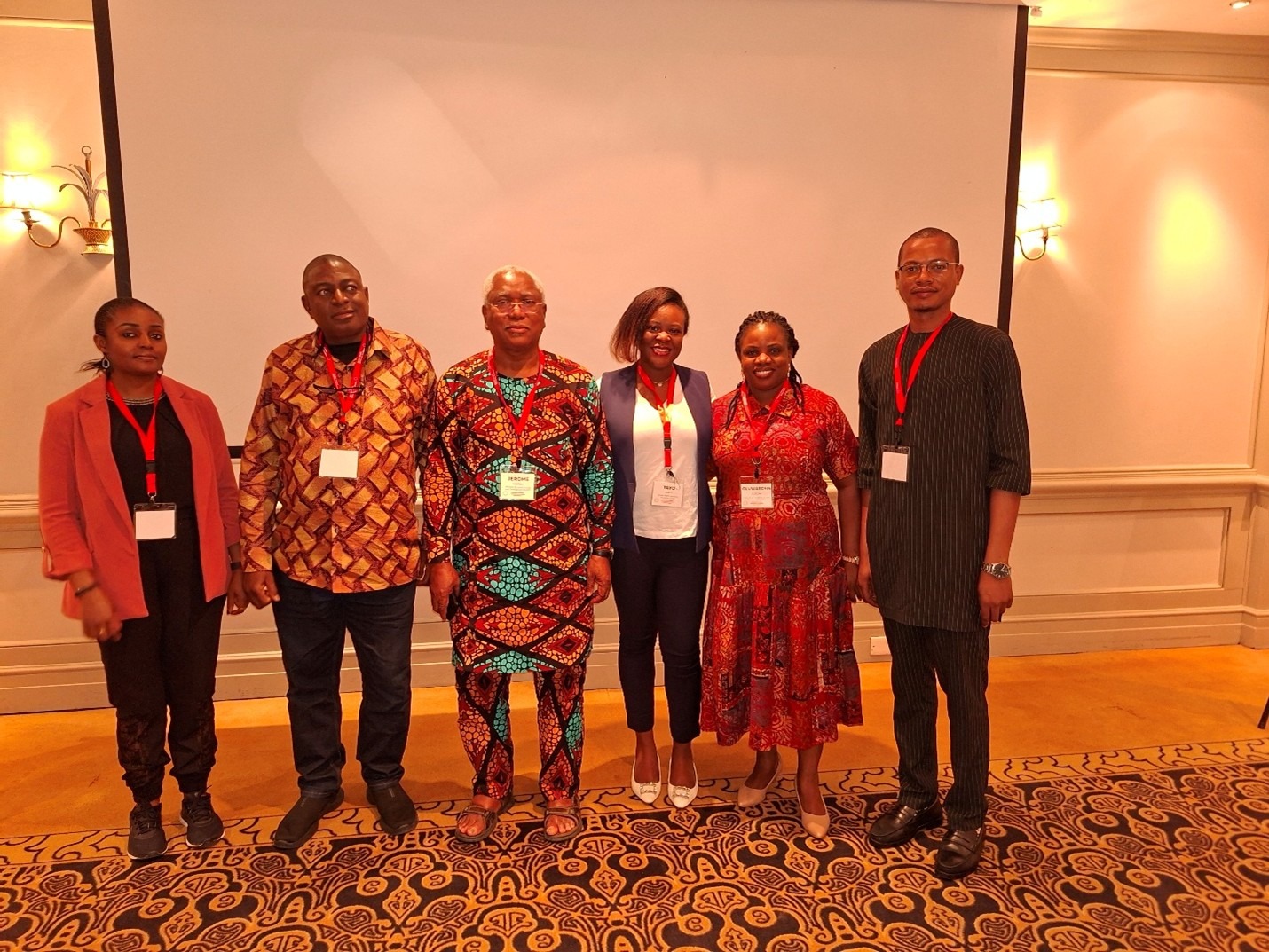
The struggle for healthy food environments in Africa continues to unfold inside a political economy shaped by corporate appetites far more powerful than any public health imperative. This was the spirit in which the Global Health Advocacy Incubator convened a regional workshop on Managing Industry Interference in Healthy Food Policies from September 10 to 12, 2025, in Nairobi, Kenya.
The workshop, designed as a technical intervention to strengthen participants’ capacity to identify, track, analyse and counter corporate interference in healthy food policymaking, brought together forty-five (45) civil society advocates from eight African countries. These included Nigeria, Ghana, Uganda, Cameroon, Tanzania, Kenya, Ethiopia, and South Africa.
Opening the sessions, Lorenna Ibarra, Senior Advisor Industry Interference, GHAI, set out the core objective of the workshop, which was to improve the monitoring capacity of civil society organisations through precise tools such as policy surveillance, analysis of industry communications, and systematic tracking of lobbying activities. She underscored that monitoring cannot be reactive or impressionistic. It must be evidence based, methodical, and capable of producing findings strong enough to influence regulatory processes.
Immediately after, Veronica Poyano, GHAI Senior Legal Advisor on GHAI’s Food Policy Program, outlined the principles guiding the workshop, including confidentiality, respect for all participants, adherence to a no sexual harassment policy, and a photo release arrangement to ensure clarity in documentation.
How Corporate Influence Manifests Across Africa
Country teams then provided structured accounts of how industry interference manifests in their national contexts. Delivering an intervention on Nigeria, Mr. Akinbode Oluwafemi, Executive Director of CAPPA, explained that the scale of Nigeria’s food industry and its deep political networks require continuous monitoring both online and offline. He highlighted that industry actors often sponsor national policy conversations, seek to control the framing of healthy food debates, and sometimes attempt to exclude civil society from key discussions. He stressed that Nigerian advocates rely on rigorously factual and unimpeachable research because industry actors consistently attempt to discredit evidence that challenges their commercial interests.
Ghana described a hyperactive set of industry associations that closely track—and often counter—public health proposals, leading advocates to use public forums and sustained public engagement to defend policies such as Front of Pack Labeling.
Ethiopia noted the reach of the food industry and highlighted United Nations Children Fund’s (UNICEF) role in supporting the development of the Nutrient Profiling Model. Kenya emphasised the value of coordinated civil society responses and strong relationships with key government actors.
Cameroon reported adopting tactics from tobacco control to track interference despite an environment where corporate and government interests are sometimes closely aligned.
Tanzania pointed to quieter forms of interference, including behind the scenes lobbying and strategic Corporate Social Responsibility initiatives.
Uganda outlined the challenge of industry accessing high political offices and spreading misleading claims that traditional foods such as bananas or millet are responsible for rising diabetes.
South Africa shared updates from its ongoing Front of Pack Labeling efforts and the difficulties created by sponsored ministerial engagements that obscure transparency.
In their joint presentation, Lorenna Ibarra and Veronica Poyano explained how a complete industry landscape analysis forms the basis for any serious advocacy strategy. They introduced a three-level model for identifying industry actors. The first level consists of companies directly producing unhealthy commodities. The second includes industry associations and front groups. The third covers public relations firms, consultancies, and think tanks responsible for shaping narratives. They explained that monitoring must be tied to a clear purpose and specific objectives. The purpose captures why monitoring is necessary in the first place, such as exposing corporate interference, while the objectives identify measurable targets such as tracking a particular lobbying effort or documenting funding flows.
Speaking further on the interpretation of monitoring results, Lorenna stressed that information has no strategic value until it is analysed and translated into forms that policymakers, the media, and the public can easily understand. Her session focused on converting raw evidence into coherent findings that strengthen the political case for regulation.
Day 2: Strengthening The Industry Strategy
On the second day, discussions moved into strategic development. Lorenna Ibarra distinguished between arguments and narratives, noting that while arguments focus on technical content, narratives carry political weight. She urged participants to pay attention to the deeper messages that corporations embed in their communications, especially those designed to frame harmful products as normal or beneficial. Her guidance was for advocates to adjust their strategies to counter these narratives with clarity and consistency.
Adeolu Adebiyi, GHAI’s Regional Senior Advisor for the Food Policy Program, followed with a session on identifying proactive opportunities. He encouraged participants to use monitoring findings to influence policy windows such as legislative sessions, shifts in public opinion, and national debates. He stressed that effective advocacy should be twenty percent reactive and eighty percent proactive.
The legal session delivered by Barrister Mikateko Mafuyeka, GHAI’s Legal Advisor for Africa, reinforced the importance of utilising legal pathways. She explained how corporations frequently deploy litigation or its threat to delay or derail public health measures. She outlined examples from Uruguay, Chile, and South Africa where advocates protected regulations such as sugary drink taxes and Front of Pack Labeling through strategic use of administrative law, constitutional provisions, and petitions.
Communication strategy was led by Pallavi Puri of Vital Strategies, who shared that communication must be intentional, data driven, and shaped around the know, feel, do logic that links information to public engagement. She highlighted the industry’s strategic use of mischievous silence, paid partnerships, and emotional messaging, and she urged advocates to build communication plans that maintain tempo across paid, earned, and owned media.
Afterwards, participants then engaged in a Word Café exercise facilitated by the GHAI team, where country teams rotated across thematic stations on political action, communication, legal strategy, and mobilization. The purpose was to identify gaps in each country’s current approach and refine their strategies with direct support from facilitators. Each team began drafting its revised national strategy to be submitted after the workshop.
Day 3: Inside the Latest Industry Tactics Sabotaging Healthy Food Policy
The third day focused on the latest industry tactics designed to obstruct healthy food policies. Participants committed to improving political action by monitoring lobbying, financial contributions, and the movement of individuals between industry and government roles. Communications strategies were further refined to counter misleading claims. Legal strategies were reinforced with renewed commitment to petitions, litigation readiness, and learning from South American and South African case studies. Mobilisation plans emphasised building stronger networks of advocates, researchers, and public figures who can coordinate rapid responses to corporate tactics.
In a final session facilitated by Adeolu Adebiyi, participants examined how industry interference operates regionally and how advocates can leverage continental and international bodies. Institutions such as ECOWAS, the East African Community, the African Continental Free Trade Area, the West Africa Health Organisation, and the Africa Centres for Disease Control and Prevention (CDC) were identified as critical platforms for inserting public health considerations into trade and investment frameworks. Participants also discussed how legal and human rights institutions such as the African Court on Human and Peoples’ Rights and the Africa Coalition on Corporate Accountability can be used to hold governments and corporations accountable for policies that undermine the right to health.
In her closing remarks, Lorenna Ibarra thanked participants and reiterated that GHAI would follow up with each country in the coming months to strengthen the implementation of their updated strategies.
Following the conclusion of the workshop, CAPPA Nigeria and HEALA South Africa held a focused conversation on collaboration under a joint Food Justice Programme. Both organisations recognised the similarities in their national battles over the Sugar Sweetened Beverage Tax and agreed to pursue shared actions including legislative engagement, coordinated media advocacy, and comparative work on the National Sugar Master Plans of both countries. They outlined next steps that include reviving regional webinars, expanding the circle of key decision makers involved in the programme, establishing a quarterly work plan, and developing a unified communication strategy for countering industry interference.