At a two-day capacity-building workshop in Kano from May 19 to 20, 2025, Corporate Accountability and Public Participation Africa (CAPPA) convened thirty-five media practitioners to deepen their understanding of Nigeria’s sugar-sweetened beverage (SSB) tax. The training fused with expert-presentations, case-studies, and hands-on exercises also equipped participants with new knowledge and investigative tools to reinforce their role as society’s watchdog and capacity to counter industry tactics to undermine public health.
In his opening remarks, CAPPA’s Executive Director Akinbode Oluwafemi noted that NCDs reportedly account for 30 per cent of Nigerian deaths, driven in no small part by excessive SSB consumption and aggressive marketing by beverage manufacturers. He critiqued the N10-per-litre SSB levy as too low, opaque in its use, and vulnerable to industry attacks. He encouraged participants to counter corporate propaganda and utilise evidence in demanding stronger fiscal policies.
Dr. Dorathy Amadi, a Deputy Director from the Federal Ministry of Health and Social Welfare (FMOHSW) delivered a goodwill message that welcomed participants to the training. She urged reporters to seize the workshop as an opportunity to hone their public-health reporting skills and to transform technical policy details into clear, compelling stories for peri-urban and rural communities where awareness is most needed.
Next, Joy Amafah, In-Country Coordinator for the Global Health Advocacy Incubator (GHAI) spoke about GHAI’s partnership with local nonprofits to advance pro-public health policies and cardiovascular health initiatives. She emphasised that collaborating with media professionals has been instrumental in driving evidence-based policy changes across Nigeria.


The first presentation of the day, titled, Cultivating the Media for People-Friendly Public Health Advocacy was delivered by Zikora Ibeh, CAPPA’s Assistant Executive Director. She deconstructed persuasive storytelling and tasked participants to humanise datasets with survivor testimonies, deploy analogies that resonate with local people, and mobilise traditional leaders to lend cultural legitimacy to media advocacy around unhealthy diets. She underscored sourcing rigour—citing the World Health Organisation, Ministry of Health, United Nations Development Programme, trusted health bodies, and peer-reviewed studies, to inoculate reports against industry legal pushback.

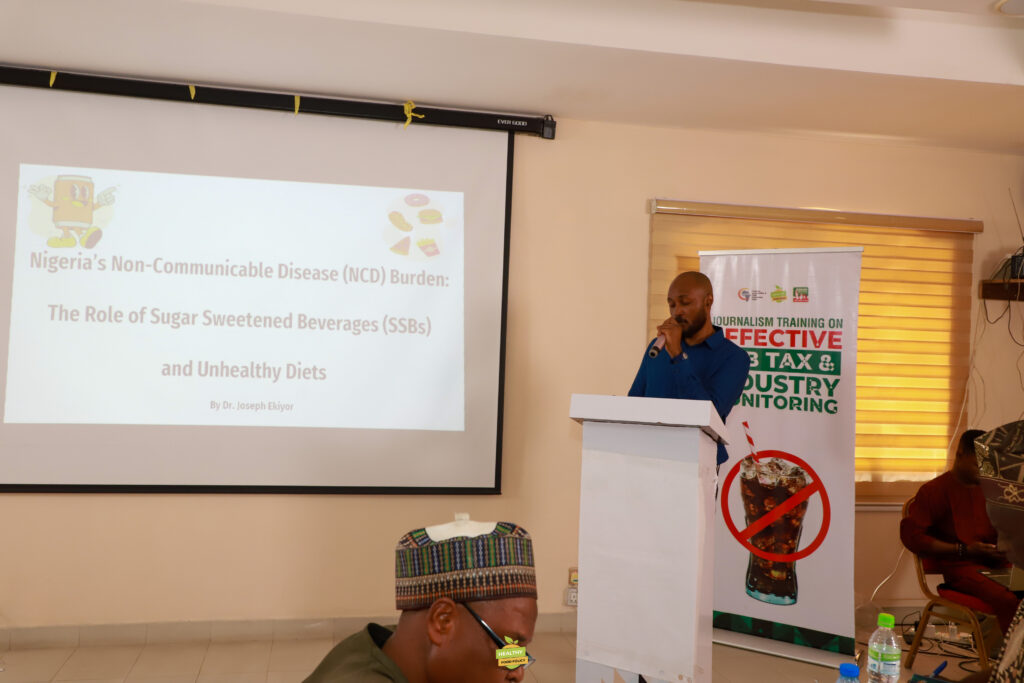
A second presentation, delivered by medical practitioner Dr. Ekiyor Joseph and titled Nigeria’s NCD Burden: The Role of SSBs and Unhealthy Diets, began by defining sugar-sweetened beverages as drinks containing added sugars and artificial sweeteners. He explained that excessive SSB consumption is a major driver of noncommunicable diseases, which caused 43 million deaths worldwide in 2021 and are projected to claim 52 million lives by 2030. Tragically, 73 per cent of these fatalities occur in low- and middle-income countries like Nigeria, accounting for 18 million premature deaths before age 70. Dr. Joseph warned that Nigeria’s food industry—shaped by globalisation and flooded with energy-dense, sugar-laden junk foods—risks exacerbating the NCD epidemic, further burdening health-care systems, undermining individual productivity, and eroding societal well-being. He closed by calling on all stakeholders, especially the media, to act urgently to confront this growing menace by shunning unhealthy nutrition and lifestyles, launching insightful public health campaigns, advocating for stricter regulations on ultra-processed foods.
Dr. Oluwatosin Edafe, a research fellow and economist with the Centre for the Studies of the Economies of Africa (CSEA) drove the home the urgency of earlier presentations quantifying the financial drag of the problem in her presentation, SSBs and Economic Impact on Households: Cost of Disease and Effective Taxation. Her presentation which wrapped up the meeting for the day revealed that N630 million is spent annually on the healthcare expenses of diet-related NCDs. She therefore advocated for an increase of the SSB tax, as well as a robust revenue pool to fund prevention
Day 2 of the workshop began with a recap of the previous day’s lessons by Humphrey Ukeaja, Industry Monitoring Officer of CAPPA.
Afterwards, Opeyemi Ibitoye, CAPPA SSB tax Project Officer presented an overview of CAPPA’s SSB tax campaign and strategies to participants. She mentioned key milestones such as the inauguration of an inter-ministerial ad-hoc committee on the SSB tax, and the setup of CAPPA’s youth vanguard to drive grassroots pressure. She flagged entrenched beverage‐industry resistance, public misconceptions about the tax, and fragmented collaboration among stakeholders as persistent challenges affecting the campaign. She prescribed unified campaign messaging, strategic multi-stakeholder alliances, and targeted lobbying of state assemblies and policymakers toward a stronger SSB tax and improving outcomes.

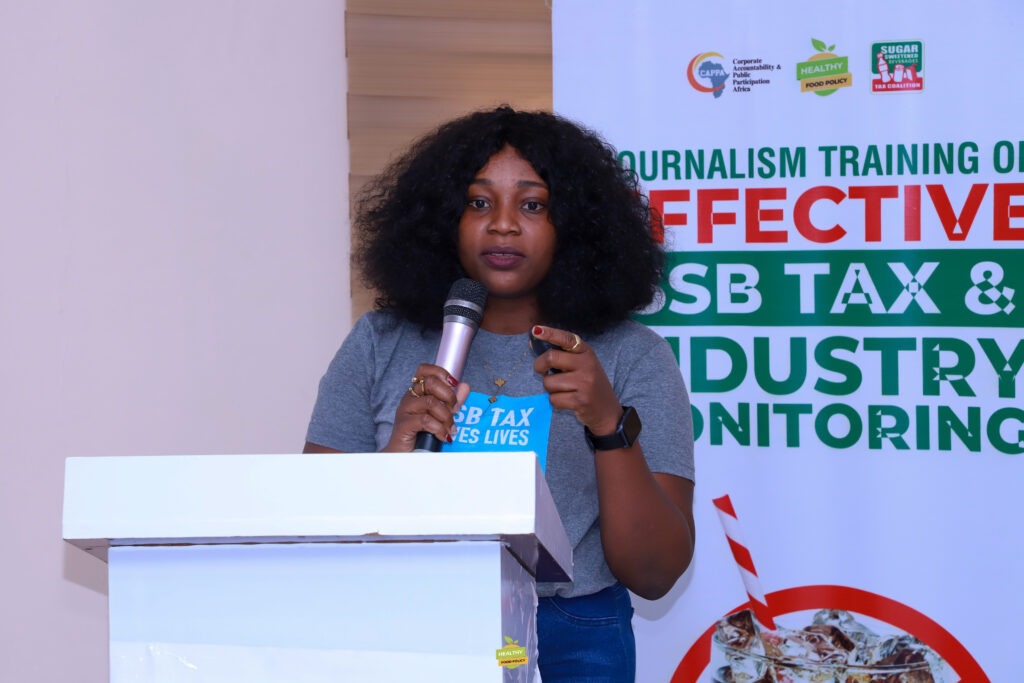
Robert Egbe, CAPPA’s Media and Communications Officer delivered the next presentation titled Effective Media Deployment for Public Health Advocacy, which taught participants how to align SSB stories with editorial calendars, utilise human-interest hooks to secure story visibility and prime placement in the news, leverage expert voices to bolster report credibility, and avoid defamation risks by opting for generic classifications rather than mentioning specific brand names—and vetting every claim through at least two independent sources.

A final session facilitated by CAPPA’s Associate Director of Food Justice Campaign, Abayomi Sarunmi unpacked Digital Media Advocacy and Tools for Extending Reach and Accountability. He showed participants how to use their mobile devices to monitor unhealthy food advertising and marketing, hold policymakers and corporations to account, as well as educate their social networks about poor diets and the merits of policy measures like the SSB tax. He also walked them through basic analytics—tracking hashtag performance and engagement metrics—so that every tweet, TikTok, Whatsapp, Instagram or even Facebook status could be evaluated for real-world impact on policy debates.

By the workshop’s close, the atmosphere crackled with possibility. Four working groups dived into a brainstorming session that developed story ideas, advocacy pathways, campaign strategies and blueprints for promoting public sensitisation and support for the SSB tax policy in Kano state. Some of the proposals included systematic brand monitoring; bi-monthly exposés; quarterly media-policymaker roundtables; and grassroots partnerships with schools, women’s associations, and youth clubs.
Participants collaborating in a group work session and presenting their findings