Corporate Accountability and Public Participation Africa (CAPPA) has called for a planned phase-down of fossil fuel dependence and greater investment in renewable energy, warning that Nigeria’s continued expansion of oil and gas activities could undermine its energy transition commitments,
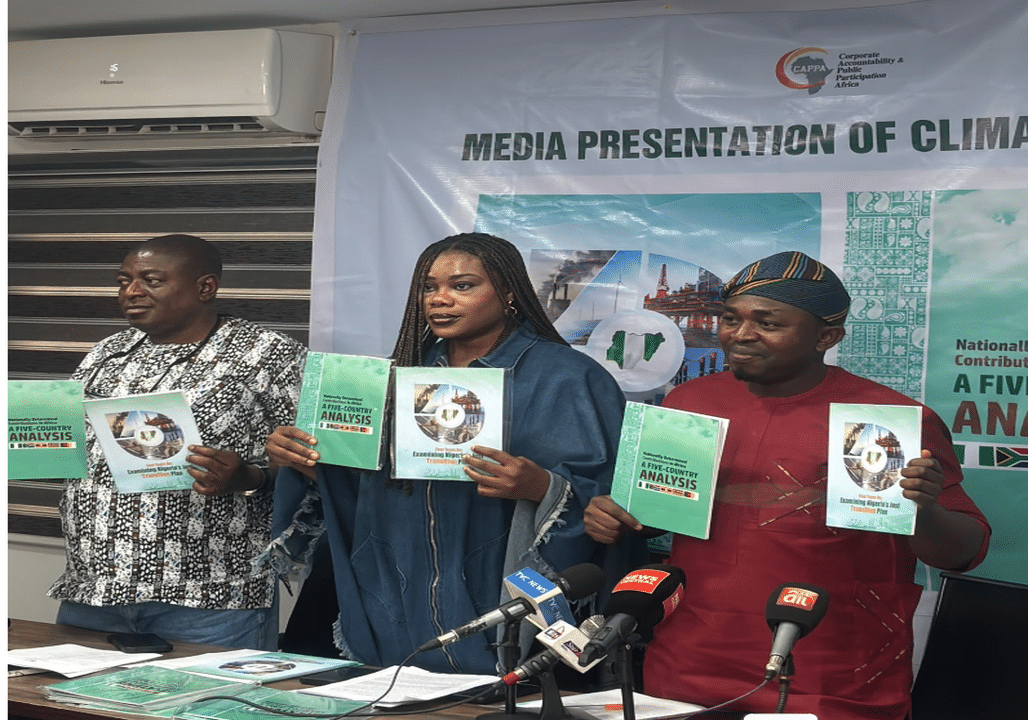
The organisation, during a media launch and dissemination of two climate reports in Lagos, also expressed concern over inadequate protections for workers and communities affected by energy projects, warning that Nigeria’s transition to cleaner energy must prioritise public welfare rather than corporate interests.
The reports, produced in collaboration with the Africa Make Big Polluters Pay Coalition (MBPP Africa), examined Nigeria’s Energy Transition Plan and the Nationally Determined Contributions (NDCs) of five African countries: Nigeria, Cameroon, South Africa, Togo and Uganda.
Titled Four Years On: Examining Nigeria’s Just Transition Plan and Nationally Determined Contributions in Africa: A Five-Country Analysis, the reports assessed the countries’ climate commitments, energy policies, financing arrangements and the implications of their transition plans for affected communities.
According to CAPPA, Nigeria’s ambition to achieve net-zero emissions by 2060 contradicts its official target of producing three million barrels of oil daily by 2030.
While acknowledging progress in policy development and renewable energy deployment, the organisation said cleaner energy initiatives were being introduced into an economy that remained heavily dependent on oil and gas, without sufficient changes to the institutions and revenue systems sustaining that dependence.
The report further identified weaknesses in the implementation of Nigeria’s transition plan, including fragmented institutional responsibilities, reliance on anticipated investments and inadequate guarantees for workers and communities.
It noted that workers affected by the transition lacked sufficiently enforceable protections covering income security, retraining and alternative employment, while communities in oil-producing areas continued to face environmental damage without adequate guarantees of restoration.
CAPPA stressed that Nigeria’s energy transition must deliver reliable and affordable electricity, noting that more than 80 million Nigerians lacked access to electricity, according to World Bank figures cited in the report.
The organisation also raised concerns about Nigeria’s climate financing arrangements, revealing that the country estimates it would require $337 billion between 2026 and 2035 to meet its climate commitments, with 80 per cent expected from international funding.
It warned that dependence on external financing, particularly loans, could deepen the economic challenges of African countries already bearing the consequences of climate change despite contributing relatively little to historical global emissions.
The five-country assessment also criticised the growing reliance on carbon markets and offsetting arrangements, arguing that they could allow major polluters to delay actual emissions reductions while shifting environmental and social costs to vulnerable communities.
Citing Uganda as an example, the report noted that its climate plan projected significantly greater emissions reductions from commercial plantations than from natural forest restoration measures. It also referenced documented forced evictions associated with a forestry and carbon-credit project in the country.
Speaking on the findings, CAPPA’s Executive Director, Akinbode Oluwafemi, said the reports presented an opportunity to reconsider how energy policies and climate commitments could better serve people and communities.
“The Nigeria Energy Transition Plan and the Five-Country NDCs Reports offer an opportunity to rethink how energy policies and climate commitments serve people and communities,” he said.
Oluwafemi added that equity, transparency and accountability must remain central to climate policies, while affected communities should have meaningful input in decisions shaping their future.
Similarly, Ndivile Mokoena, Founder and Chief Executive of Yielding Intersectional Movements, a South African partner organisation of MBPP Africa, called for tangible implementation of climate commitments, adequate financing and meaningful support for developing countries.
Kwami Kpondzo, Executive Director of the Centre pour la Justice Environnementale in Togo, also criticised carbon markets and geoengineering, describing them as distractions that could worsen the conditions of vulnerable communities.
In its recommendations, CAPPA called on African climate negotiators to reject carbon offsetting as a substitute for actual emissions reductions and strengthen safeguards against corporate influence in national climate policies.
The organisation also demanded grant-based climate financing from historically high-emitting countries, legal protection for communal lands and greater participation of Indigenous Peoples, farmers, rural women and other vulnerable groups in climate-related decisions.
It further urged African governments to pursue a planned and adequately funded reduction in fossil fuel extraction, supported by public investment in decentralised renewable energy, affordable electricity, retraining programmes and environmental restoration.
The reports were launched as governments, climate negotiators and civil society organisations gathered in Antalya, Türkiye, for the 31st United Nations Climate Change Conference (COP31).
Source: Pmnewsnigeria