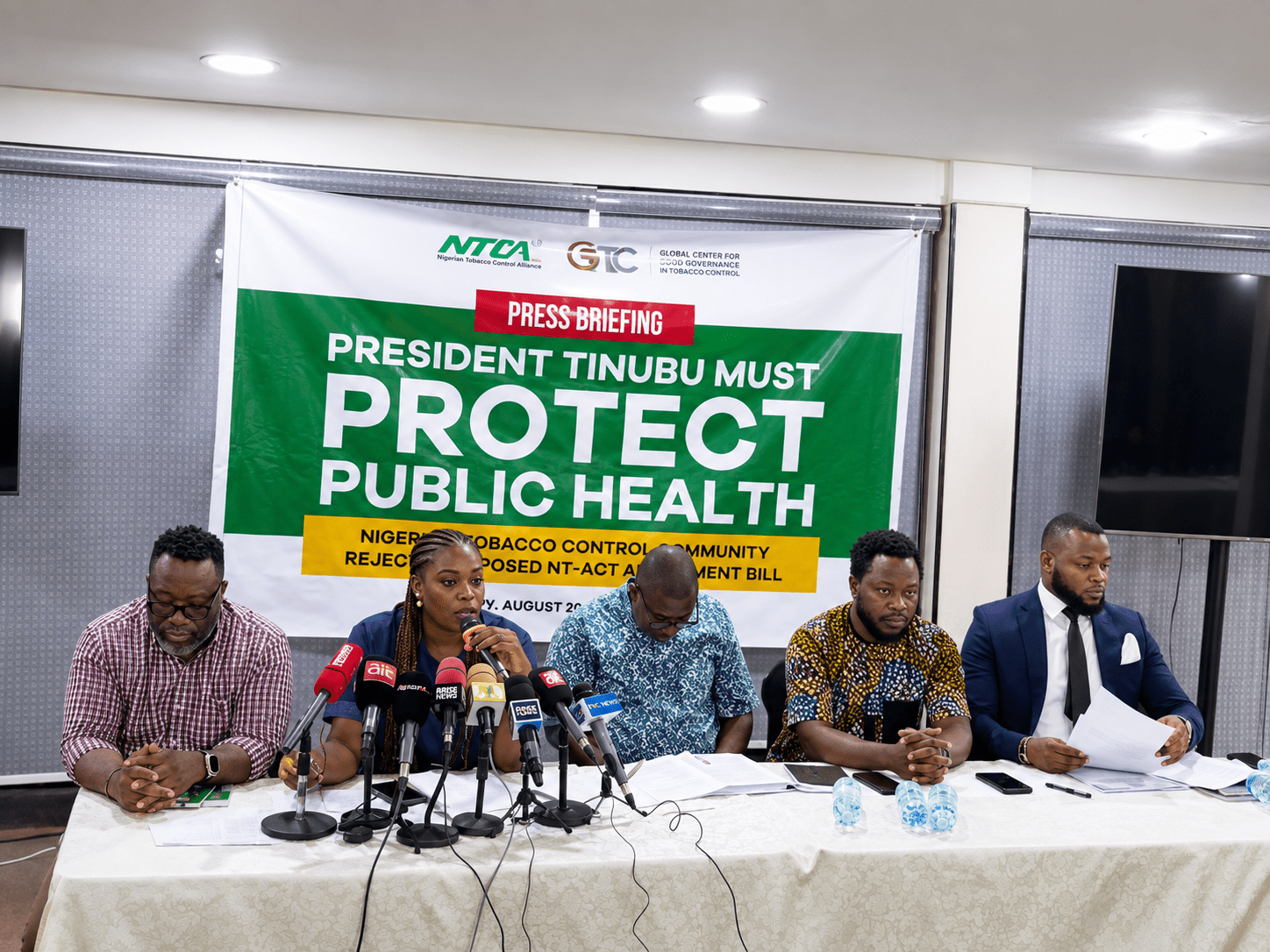
On August 9, 2026, the Nigeria Tobacco Control Community, a coalition of more than 100 public health advocates, civil society organisations and non-governmental organisations working to strengthen tobacco control in Nigeria, held a press conference to reject the proposed amendment to the National Tobacco Control Act (NTCA) 2015 and call for the withdrawal and comprehensive review of the Bill.
The press conference was attended by representatives of 35 media organisations across television, newspapers, radio and online platforms. Speakers included representatives of the Campaign for Tobacco-Free Kids (CTFK), Nigerian Tobacco Control Alliance (NTCA), Corporate Accountability and Public Participation Africa (CAPPA), and A New Thing International Foundation.
In his opening remarks, CAPPA’s Executive Director, Akinbode Oluwafemi, acknowledged the need to update the National Tobacco Control Act 2015 and its 2019 Regulations to address emerging tobacco and nicotine products. He, however, expressed concern that the proposed amendment could create regulatory loopholes for products such as vapes, heated tobacco products and nicotine pouches.
Oluwafemi described the consolidated National Tobacco Control Act (Amendment) Bill 2025 as a potentially dangerous departure from Nigeria’s existing tobacco-control framework. He said the proposed provisions could expose millions of Nigerians, particularly young people, to increased promotion and easier access to emerging tobacco and nicotine products.
“Our conclusion is that this Bill does not protect Nigerians. It instead weakens existing safeguards and creates a wide-open market for tobacco and nicotine companies to thrive at the expense of public health. We demand its immediate recall for a comprehensive and transparent review,” Oluwafemi said.
He also raised concerns about provisions that could permit advertising of non-combustible tobacco and nicotine products through adult publications, point-of-sale materials and online platforms, as well as sponsorship of cultural, social and recreational events. Oluwafemi questioned the Bill’s proposed definition of an “adult publication” as one with at least 50 per cent adult readership, arguing that such a threshold could still expose children to tobacco and nicotine advertising.
He also rejected the proposed classification of heated tobacco products as non-combustible products, noting that they contain tobacco and nicotine.
“The fact that this, what we call the bill today, has gone this far is already a shame because if you read this, that this actually passed through the point at which somebody said they want to transmit it to the president, it’s actually a shame on us as Nigerians,” he said. He urged President Bola Tinubu not to assent to the Bill and called for its recall and comprehensive review.
Health Ministry must clarify stand
Oluwafemi also called on the Federal Ministry of Health and Social Welfare to publicly clarify its position on the proposed amendment.
He said that if the Minister of Health had not been adequately consulted during the legislative process, the Ministry should seek the recall of the Bill.
He described the proposed legislation as an embarrassment for Nigeria and urged the President to withhold assent pending a transparent review.
Legal and policy concerns
Speaking on the legal, policy and public health implications of the proposed amendment, CTFK Country Director Michael Olaniyan raised concerns about provisions relating to advertising, sponsorship, health warnings, penalties and ministerial powers.
Olaniyan argued that allowing tobacco and nicotine companies to sponsor cultural, social and recreational events, even where such events are ostensibly directed at adults, would not adequately protect young people in a highly digital environment. He noted that images and branded content from such events could be shared online and amplified through social-media platforms.
He also said the Bill would reduce the size of health warnings and remove penalties for non-compliance, while granting the Minister broad discretion over product regulation.
Olaniyan specifically cited Paragraph 21, which he said would give the Minister powers to exempt non-combustible products from provisions of the Bill on undefined public-interest grounds. He argued that such provisions could create opportunities for lobbying and regulatory capture.
Tracing the Bill’s history, he noted that there were originally two bills, HB 47 and HB 1151, but were consolidated into a single Bill.
Concerns over the legislative process
Olaniyan also discussed the history of the proposed amendment. He said it originated from two separate Bills, HB 47 and HB 1151, which were subsequently consolidated.
According to him, the consolidated Bill differs significantly from the versions presented at a public hearing on November 22, 2024. He alleged that recommendations made during the public process were not adequately reflected in the current version and questioned how the new provisions were introduced.
He called for greater transparency around the legislative process, including the publication of committee reports, voting records and stakeholder submissions relating to the development of the Bill.
“When they were presented at a public hearing on 22 November 2024, they contained none of these worrying concessions,” Olaniyan said. “Who introduced these provisions, and which public-health institutions reviewed them? The public has been completely excluded from the process that produced these dangerous alterations.”
Olaniyan further urged the Federal Ministry of Health and Social Welfare to take a stronger position in defence of existing tobacco-control protections.
Online sales and retail provisions
The Alliance Coordinator of the NTCA, Olawale Makanjuola, raised concerns about provisions relating to the online sale and delivery of non-combustible tobacco products.
He argued that age-verification measures could be circumvented and that Nigeria currently lacked the capacity to effectively monitor the websites, social-media sellers, courier companies and delivery services involved in such transactions.
Makanjuola also criticised provisions that would permit the display of non-combustible tobacco products behind retail counters and reduce the minimum pack size for cigars from 20 to five.
Concerns over “tobacco harm reduction”
Another major issue raised at the press conference was the proposed inclusion of “tobacco harm reduction objectives” in the Bill.
CAPPA’s Assistant Executive Director, Zikora Ibeh, and A New Thing International Foundation’s Executive Director, Kenneth Anetor, were among the speakers who opposed the inclusion of the concept.
They argued that the proposed provision could be used to justify weaker regulation of emerging tobacco and nicotine products. Olaniyan summarised the coalition’s position by stating that “harm reduction is not harm elimination.”
Ibeh specifically criticised Clause 16, which she described as contradictory because it reportedly classifies heated tobacco products as non-combustible while excluding non-combustible products from the legal definition of tobacco products.
She argued that heated tobacco products contain tobacco and should therefore remain subject to tobacco-control restrictions.
The coalition further argued that changing the legal classification of tobacco products based on whether tobacco is heated or burned could establish a problematic precedent for tobacco-control policy in Nigeria and potentially elsewhere in Africa.
The coalition also referred to the World Health Organization’s position that heated tobacco products are tobacco products and should be regulated accordingly.
Key demands
The press conference, called for the following:
“The National Assembly should recall the consolidated National Tobacco Control Act (Amendment) Bill 2025 and subject it to a transparent, public-health-led review.
“The National Assembly should publish relevant committee reports, voting records and stakeholder submissions that informed the development of the Bill.
“The Federal Ministry of Health and Social Welfare should publicly clarify its position on the proposed amendment and seek its recall if the Ministry was not adequately consulted.
“President Bola Ahmed Tinubu should withhold assent if the Bill reaches his desk in its current form.
“Existing prohibitions on advertising, sponsorship, sampling, retail display and remote sales of tobacco and nicotine products should be maintained.
“Nigeria should preserve strong safeguards against the promotion and accessibility of tobacco and nicotine products, particularly among young people.”
The coalition also urged public-health professionals, civil society organisations, young people, parents, the media and other stakeholders to remain engaged in efforts to protect Nigeria’s tobacco-control framework.
It warned that weakening existing safeguards could expose future generations to increased tobacco and nicotine use and associated preventable health harms.
Conclusion
The press conference provided a platform for members of the Nigeria Tobacco Control Community to express concerns about the proposed amendment to the National Tobacco Control Act and its potential implications for tobacco and nicotine regulation in Nigeria.
Across their interventions, speakers called for greater transparency in the legislative process, preservation of existing tobacco-control safeguards and a comprehensive review of provisions they believe could weaken restrictions on emerging tobacco and nicotine products.
The coalition’s central position was that any effort to modernise Nigeria’s tobacco-control framework should strengthen, rather than weaken, protections against tobacco and nicotine-related harm, particularly for young people.