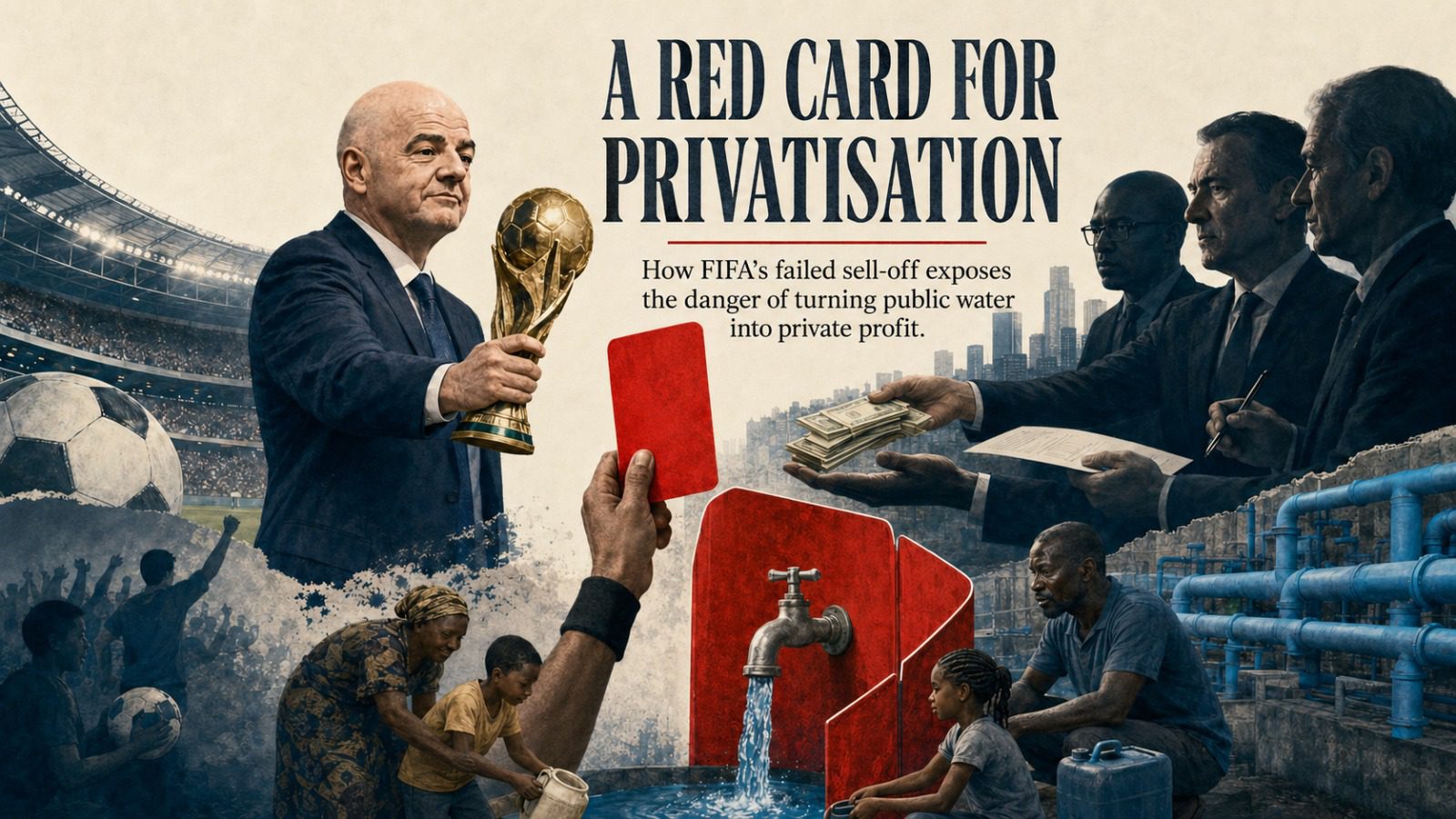
Gianni Infantino’s failed bid to sell part of FIFA’s commercial future offers a wider lesson about the corporate capture of public services and the struggle to keep water in public hands.
Gianni Infantino needed less than a week to discover that even global football has limits. On July 28, the FIFA president unveiled FIFA Forward Enterprise, a proposed $20 billion company that would consolidate the commercial and tournament operations of the World Cup and FIFA’s other competitions. Private investors would pay as much as $4.2 billion for a stake of up to 20 per cent.
The proposal was presented in the familiar language of growth and development. Fresh capital would flow into the game, while smaller and poorer national associations would receive more resources to strengthen grassroots programmes and nurture young talent. To sweeten the offer, FIFA promised each of its 211 member associations up to $20 million in immediate funding if they endorsed the scheme by September 19.
Yet Infantino’s gamble rested on a serious financial and political misjudgement. FIFA is not a struggling start-up searching for venture capital to build infrastructure. It is a cash-generating organisation with billions of dollars in reserve, buoyed by lucrative broadcasting and sponsorship agreements and in control of one of the most valuable properties in global entertainment. Surrendering one-fifth of the World Cup’s commercial operations for a one-off payment made little economic sense. Private investors do not commit $4.2 billion as an act of goodwill. They do so because they expect returns that far exceed their original outlay. The arrangement would therefore have exchanged a lasting claim on football’s future earnings for money that could only be spent once.
Although Infantino denied that the arrangement amounted privatising the World Cup, resistance to the proposal was swift and uncompromising. UEFA and its 55 member associations threatened to boycott all FIFA competitions unless the project was withdrawn, condemning it as an “irreversible capture” of football’s greatest tournaments. CONCACAF, representing North America, Central America, and the Caribbean, also rejected the initiative, while the Asian Football Confederation joined the opposition. Dissent also hardened within FIFA. Senior adviser Carlos Cordeiro resigned and denounced the project as a bad deal for football, while Chief Operating Officer Kevin Lamour said employees had been deceived.
Faced with a widening revolt and no credible route to approval, Infantino called time on the plan by the end of July. Even so, the controversy has continued to provoke debate about what it truly means for an institution built on collective values to remain free from vested private interests. Beyond football, the episode offers a revealing window into the politics of privatisation. The FIFA imbroglio reflects a much broader pattern in which essential public services and shared resources are gradually opened to commercial interests, often under the promise of greater efficiency, investment and growth.
Traditionally, privatisation referred to the outright sale of a public enterprise or the transfer of its ownership to private hands. Today, it is often pursued through more subtle arrangements, including public-private partnerships, concessions, outsourcing contracts, management agreements and the sale of minority stakes. Ownership may formally remain public, but commercial interests increasingly shape how public institutions are governed and operated.
Over the past few decades, this commercial logic has steadily expanded into areas once regarded as core state obligations and responsibilities. Housing, healthcare, education, water and sanitation are increasingly expected to operate according to market principles. Cost recovery, financial sustainability and investor confidence have become defining measures of success, often taking precedence over universal access, equity and social welfare.
The pursuit of financial returns ultimately alters the purpose of public services. Public provision begins with the needs of society, including the welfare of people who cannot afford to pay the full cost of what they require. Commercial enterprises, by contrast, are governed primarily by the imperative to generate returns. Once that shift occurs, citizens are recast as customers, access becomes a transaction and those without sufficient means become commercially unattractive.
Governments often prepare the ground for this transition through years of chronic neglect and inadequate investment. Budgets contract, infrastructure deteriorates, skilled workers leave, and service quality declines until public frustration becomes widespread. Private investors are then introduced as rescuers, while the policy choices and administrative failures that produced the decay recede from view. What resulted from underfunding and poor governance is recast as the unavoidable failure of public provision.
There is also a glaring contradiction in this reasoning. Governments that were too weak or inefficient to manage public utilities suddenly promise they will effectively regulate the powerful corporations invited to operate them. Yet negotiating and enforcing complex agreements with powerful corporations often demands greater expertise, independence, and political courage than running the service directly. If a state cannot prevent neglect while exercising direct control, there is little reason to believe it will suddenly become a fearless watchdog after handing over key operational responsibilities.
Water brings this danger into its starkest relief because nobody can choose to live without it. It is indispensable to drinking, sanitation, agriculture, and public health, yet 2.1 billion people still lack safely managed drinking water. Most are not deprived because the world lacks the technical knowledge to supply them. They are excluded by poverty, unequal development, failing infrastructure, and political decisions about whose lives deserve public investment.
Water networks also tend to operate as natural monopolies. Households cannot switch to a competing set of pipes when tariffs rise or service deteriorates, which gives whoever controls the system enormous power over daily life. This makes the transfer of water services to corporate operators especially dangerous in places where regulation is weak and large sections of the population already struggle to meet basic expenses.
When governments bring private companies into water systems, they promise new infrastructure and greater efficiency but rarely explain how investors will generate their returns. Those returns are typically secured through higher tariffs, workforce reductions, guaranteed public payments or investment concentrated in wealthier areas where residents can pay more. The public ultimately finances the company through taxes, subsidies and water bills while surrendering meaningful control over the service. The operator’s balance sheet may improve, but the real costs are simply transferred to households in the form of higher living expenses, deteriorating access and avoidable hardship.
None of this suggests that public ownership should excuse corruption, inefficiency or neglect. Public utilities require reform, adequate financing and democratic accountability. Their workers deserve fair pay and proper training. Their finances should be transparent, and communities should have a direct voice in decisions about management, investment and expansion.
The football world rejected Infantino’s proposal because many concluded that allowing private investors into the governance of the World Cup would permanently rewrite the rules of the game to serve investor returns. The lesson extends well beyond football. Opening essential public services to the same logic does not relieve governments of their responsibilities. It inserts profit-seeking intermediaries into institutions meant to keep people alive.
The stakes are far higher at the water tap than on the football field. Communities can live without the World Cup but cannot survive without water.