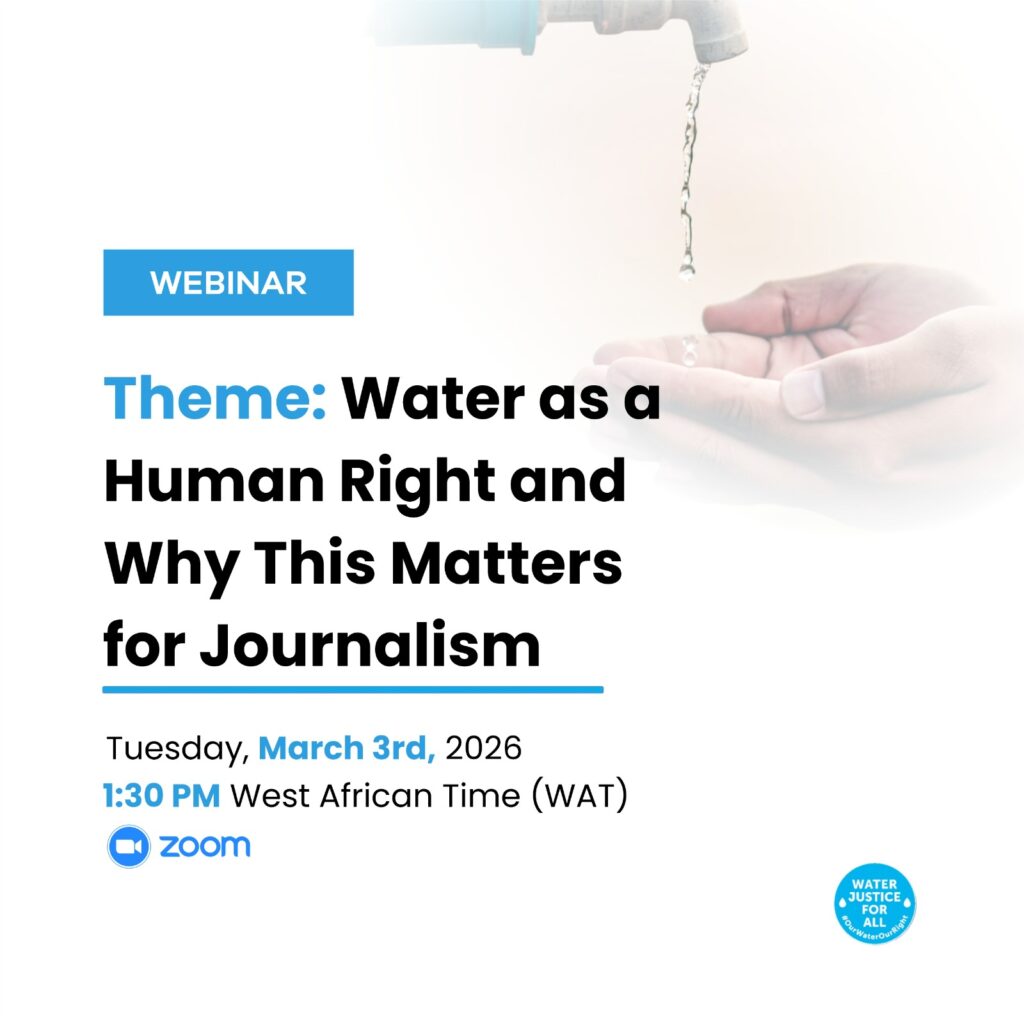
On 3 March 2026, the Our Water Our Right Africa Coalition (OWORAC) convened a virtual training for journalists in Zimbabwe aimed at strengthening rights-based reporting on water governance and accountability. The session brought together about twenty journalists from across Zimbabwe, alongside water justice advocates and policy experts joining from Nigeria and the United States. Hosted by the Corporate Accountability and Public Participation Africa (CAPPA), the training formed part of the coalition’s broader continental effort to deepen scrutiny of water governance and to equip journalists with the analytical tools required to interrogate the politics shaping access to water across Africa.
Opening the session, Khumbulani Maphosa, Coordinator of Voices for Water in Zimbabwe, situated the conversation within the country’s constitutional framework, which recognises access to water as a right. He noted, however, that legal recognition does not automatically translate into meaningful access for communities. Across Zimbabwe, water infrastructure continues to suffer from chronic underfunding by the national treasury, while local authorities often lack the resources required to maintain treatment plants and distribution systems.
Environmental pressures further complicate the situation. Mining activities have intensified water pollution in several regions, and the discharge of untreated sewage into rivers and streams continues to threaten both ecosystems and public health. These challenges are unfolding alongside emerging policy discussions around centralized water privatisation and increased private sector participation in water delivery. Maphosa emphasised that the distance between constitutional guarantees and everyday reality remains wide, underscoring the importance of journalism in exposing governance failures and amplifying community voices.
Holiness Segun-Olufemi, Programme Officer for the Water Campaign at CAPPA followed with an introduction to the Our Water Our Right Africa Coalition and its work across the African continent. She described OWORAC as a growing Pan-African network of grassroots movements, labour unions, journalists, and civil society organisations committed to defending water as a public good and a fundamental human right. She also explained that OWORAC’s work focuses on monitoring water privatisation trends across Africa, documenting the lived experiences of communities affected by water access failures, challenging opaque public-private partnerships, and advocating for transparent and publicly financed water systems that prioritise community needs rather than corporate returns. Within this context, journalism plays a decisive role in shaping public understanding. The stories journalists tell influence whether citizens see themselves as consumers purchasing a service or as rights holders entitled to water by law.
The first training session for the day was led by Zikora Ibeh, Assistant Executive Director at CAPPA, who examined water as a human right and why this framework matters for journalism. She explained that when governments provide water services, they are not performing charity but fulfilling a legal and moral obligation recognised even in international human rights law. This obligation was affirmed in 2010 when the United Nations General Assembly recognised the human right to safe and clean drinking water and sanitation. The right requires that water be available in sufficient quantities, physically accessible, affordable, safe for consumption, and delivered without discrimination. Yet across Africa more than 411 million people still lack reliable access to clean and affordable water, reflecting not only infrastructure gaps but deeper governance failures.
Ibeh also explored the tension between rights-based water governance and market driven reforms that prioritise cost recovery and investor returns. While rights frameworks pursue universal access and democratic accountability, privatisation models often reorganise water systems around profit incentives. She encouraged journalists to translate these policy debates into clear public narratives by tracking procurement processes, interrogating tariff decisions, examining who benefits from infrastructure contracts, and documenting how water scarcity disproportionately affects women and girls. In this way, journalism becomes a vital instrument for public accountability in water governance.
Neil Gupta, Water Campaign Director at Corporate Accountability, examined global patterns of water privatisation and the role of multinational corporations such as Veolia and Suez in water management. He explained that privatisation often occurs through public-private partnerships that transfer operational control of water infrastructure from public authorities to private firms. Though presented as efficiency reforms, these arrangements can shift water governance toward profit, pushing universal access into the background. In many cases, privatisation has been followed by tariff increases, service disconnections for households unable to pay, labour cuts in utilities, and delayed maintenance of infrastructure.
Gupta also highlighted the role of international financial institutions such as the World Bank and the International Monetary Fund, which often promote private sector participation to address financing gaps in water infrastructure. Drawing on global case studies, he pointed to both the risks of privatisation and the growing resistance to it. Cities such as Paris have returned water systems to public control, while experiences in Flint and Pittsburgh in the United States, as well as Tanzania and Gabon, reveal the governance and accountability challenges that often accompany privatisation. Since 2007, more than three hundred cities worldwide have reclaimed public control of their water systems.
Bukola Coker, an award-winning journalist with Channels Television, facilitated the final learning session. She spoke on strengthening investigative reporting on water. She noted that media coverage often focuses on disasters such as floods or system breakdowns, while the deeper governance failures behind these crises remain poorly examined. Journalists, she argued, must pay closer attention to the everyday functioning of water systems by investigating dams and treatment plants, reviewing maintenance records, examining abandoned infrastructure projects, and questioning the sustainability of donor-funded initiatives.
Budget scrutiny is also critical. Tracking government allocations to water ministries and utilities can expose underinvestment, procurement irregularities, or funds that never translate into services for communities. Coker stressed that reporting must also be grounded in lived realities. Data becomes meaningful when connected to households relying on unsafe water sources or communities where women spend hours securing water. Investigative reporting therefore, requires a combination of financial scrutiny, policy analysis, and community storytelling, carried out with ethical engagement and trust building with affected communities. Without such scrutiny, governance failures persist, leaving societies more vulnerable to privatisation pressures, waterborne diseases, preventable deaths, and deepening poverty.
The highly engaging training drew active participation and concluded with positive feedback from media practitioners in attendance. It also marked an important step toward building a network of informed journalists reporting on water governance through a rights-based lens in Zimbabwe. By connecting media professionals and water justice advocates across countries, OWORAC is strengthening collaboration and cross-border investigation on water policy across Africa.