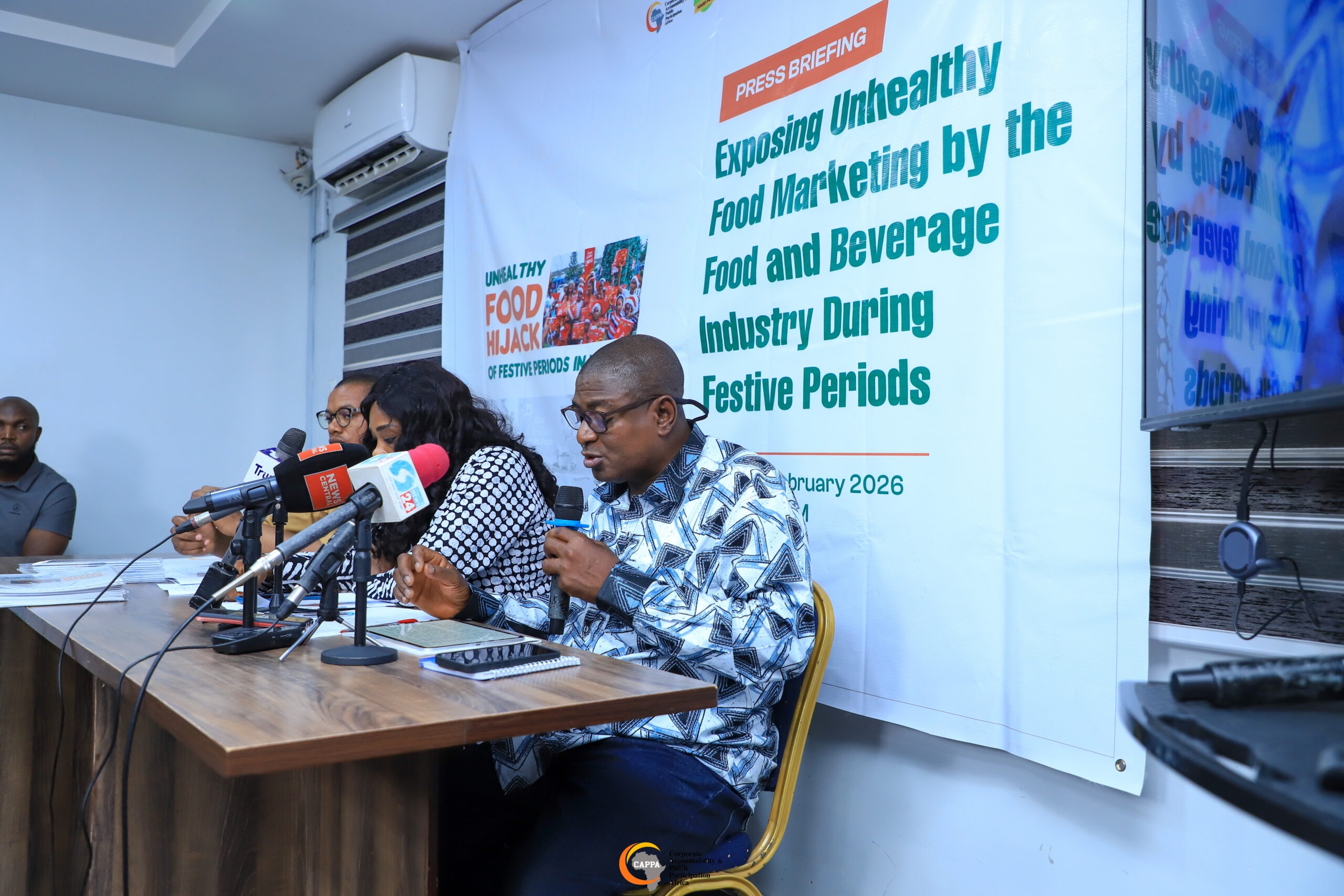
On February 4, 2026, the Corporate Accountability and Public Participation Africa (CAPPA) convened journalists, public health advocates, and civil society actors at its Lagos headquarters to launch a new report, Unhealthy Food Hijack of Festive Periods in Nigeria.
The report drew on a monitoring conducted by CAPPA between November 2025 and January 2026 across major cities, including Lagos, Abuja, and Onitsha, documenting how food and beverage corporations used the festive season to intensify the promotion of sugar-sweetened beverages and ultra-processed foods. The press briefing laid bare how Nigeria’s festive periods have become prime commercial terrain, where corporate marketing strategies are woven into celebration, generosity, and care.

In her welcome remarks, Zikora Ibeh, Assistant Executive Director of CAPPA, described the 2025 festive period as very sophisticated in terms of marketing and promotional strategies employed by many brands. Major cities such as Lagos, Abuja, and Onitsha were saturated with varying adverts that influenced people to indulge more unhealthy foods. Companies deployed an omnichannel strategy that fused physical installations with digital storytelling, using AI-driven content, Christmas villages, music concerts, and themed public spaces to turn ordinary social engagement into unpaid brand promotion. Nutritional information of many products was conspicuously absent. In its place were emotional cues centred on family, magic, and togetherness, narratives that quietly recast branded products as indispensable to the Nigerian Christmas experience.

CAPPA’s Executive Director, Akinbode Oluwafemi, pushed the analysis further, situating festive marketing within Nigeria’s escalating non-communicable disease crisis. He argued that these campaigns act as risk multipliers, intensifying exposure to unhealthy products at precisely the moments when consumption peaks. Drawing parallels with the tobacco industry’s long history of reputation laundering, he also revealed that companies often hide behind so-called corporate social responsibility activities to improve their public image. While companies record higher sales during the festive season, he noted that the real costs are quietly transferred to households and to an already overstretched health system grappling with hypertension, diabetes, and other diet-related illnesses.
Presenting findings from the monitoring and fieldwork, Humphrey Ukeaja, CAPPA’s Industry Monitoring Officer, explained how companies tailored their marketing to different groups. Children were targeted through the use of mascots, school donations, and branded materials in learning spaces. Young people were reached through online challenges, influencer content, and partnerships with major music events such as Flytime Fest. In low-income communities, companies used Corporate Social Responsibility activities like community cook-offs and park decorations to expand their presence and build goodwill while promoting their brands.

Ukeaja noted that many of these strategies rely heavily on digital tools. Influencers, online games, and “scan-to-win” promotions blur the line between advertising and entertainment. This makes the marketing less obvious to consumers and harder for regulators to track and control.
Against this backdrop, CAPPA used the launch to press for urgent policy action. The organisation called for legally binding restrictions on the advertising of unhealthy foods, with particular emphasis on banning influencer marketing and youth-targeted digital promotions. It reiterated its demand for a strengthened sugar-sweetened beverage tax set at 50 percent of the retail price, with revenues dedicated to non-communicable disease prevention. CAPPA also urged the prohibition of branded CSR activities in sensitive spaces such as schools and religious institutions, alongside the introduction of mandatory front-of-pack warning labels to restore a minimum level of consumer transparency.

The report was formally launched by the CAPPA team before the session opened into a wide-ranging discussion. Questions from journalists and advocates focused on marketing to children, the role of seasoning cubes in excessive sodium intake, and the need for stronger collaboration with the National Orientation Agency. CAPPA representatives reaffirmed their commitment to building community power and prioritising public health over corporate profit, while noting their support for regulatory actions by NAFDAC, including the ban on sachet alcohol and restrictions on marketing to children.